Simple habits that take just a few seconds before your ride but can make your trip safer — especially when you're traveling in a new city.
 5 min read
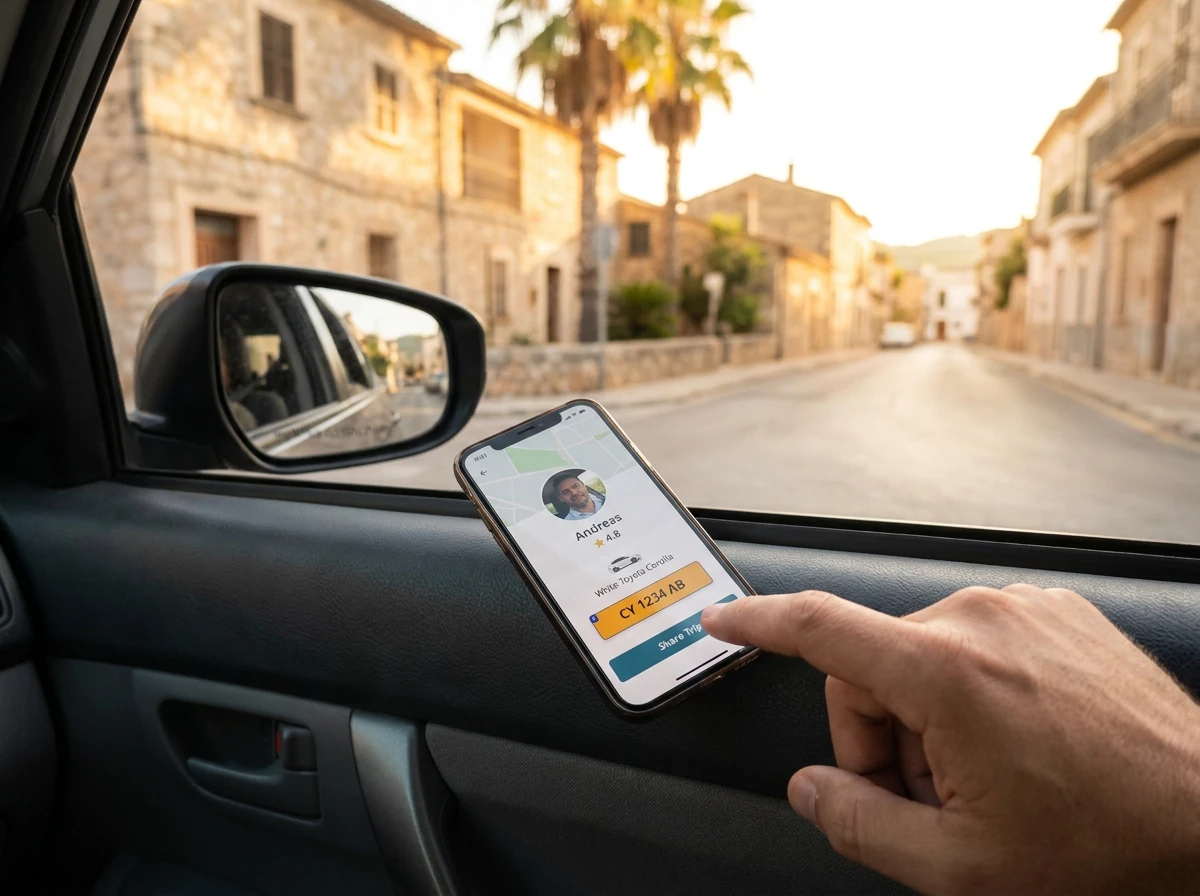
This image was AI-generated with Nano Banana Pro for illustrative purposes only.
The first piece of information available to you in any ride-hailing app is the driver's rating. It takes literally two seconds to glance at it, but those two seconds can tell you a lot. A rating below 4.5 out of 5 is a signal — not necessarily a dealbreaker, but a reason to look closer at the reviews. Read what other passengers wrote, especially the recent ones. Patterns like 'didn't follow the route', 'aggressive driving', or 'uncomfortable car' are worth noting.
In some markets, particularly in Southern Europe and the Eastern Mediterranean, ratings tend to average slightly lower than in Central or Northern Europe. A 4.6 in Cyprus might mean the same thing as a 4.8 in London. Context matters, but the principle remains: if multiple recent reviews mention the same concern, consider ordering a different car.
Every major ride-hailing app has a 'Share trip' button that sends your live location, driver details, and estimated arrival to a contact of your choice. Use it. It's not paranoia — it's a standard safety practice. The person you share with doesn't need to follow your ride in real time. They just need to have the information in case something goes sideways.
If you're using a traditional taxi without an app, send a quick message with the license plate, car color, and your destination. In Cyprus, where many visitors rely on pre-booked transfers rather than apps, this is especially relevant. The driver's name and phone number are usually provided in the booking confirmation — forward that to someone at home.
This habit is especially important at night, in unfamiliar areas, and when you're traveling alone. It takes five seconds and gives both you and your contact peace of mind for the entire duration of the ride.
"Sharing your ride details isn't about expecting the worst — it's about making sure someone knows where you are, even when everything goes right."
Before opening the door, match the car's make, color, and license plate with what's shown in your booking. It's the single most effective way to confirm you're getting into the right vehicle. License plates are unique — make and color are not. If the plate doesn't match, do not get in, even if the driver insists everything is correct.
In Cyprus, licensed taxis and transfer vehicles must display a municipal or transport ministry permit. Look for a visible badge or sticker, usually on the windshield or the passenger-side dashboard. Unlicensed vehicles may look identical from the outside, but they operate outside any regulatory framework — no insurance coverage for passengers, no accountability mechanism, no driver background checks.
If you've booked a transfer through a service like QTaxi, the confirmation includes the driver's name, phone number, and vehicle details. Take a moment to compare all three when the car arrives. It's a small effort that eliminates a significant category of risk.
The back seat gives you distance from the driver — both physical and psychological. It's easier to exit quickly from the back, you're less exposed in a collision, and it naturally establishes a professional boundary. In most countries, sitting in the back is the default and expected behavior. Only in a few cultures — parts of Ireland, New Zealand, and rural Australia — is the front seat considered polite.
The rear seat behind the driver is statistically the safest position in any car. In a side-impact collision, the passenger side is the most vulnerable. If you're alone, center rear is ideal but often uncomfortable. Behind the driver is the practical middle ground — safe and universally acceptable.

Fixed prices, flight tracking and a driver waiting on arrival
Your phone is your most important travel tool — it's your map, your payment method, your communication channel, and your emergency contact all in one. A dead phone in a taxi ride, especially at night in an unfamiliar city, is not a situation you want to find yourself in.
Carry a small power bank if you're going to be out for the whole day. Most taxi rides are short, but if you're relying on your phone for navigation after the ride — for walking to your hotel, finding a restaurant, or calling someone — a dead battery creates a chain of problems. Charge your phone during airport layovers, hotel stops, and meal breaks.
Keep your phone in your hand or in an easily accessible pocket, not buried in the bottom of a backpack. If you need to call someone, share your location, or take a photo of the license plate, you want to be able to do it in seconds, not minutes.
If something feels wrong — the car doesn't match, the driver's behavior is off, the route seems to be going in the wrong direction, or you simply feel uncomfortable — you have every right to cancel or ask to be dropped off at a safe, public location. No ride is worth ignoring a gut feeling. In Cyprus, towns are small and well-lit, so finding a busy street or hotel lobby to step out is rarely difficult.
Most rides go exactly as planned. The vast majority of drivers are professionals doing an honest job. But the small percentage that doesn't fit that description is the reason these habits exist. They're not about living in fear — they're about making safety a default, not an afterthought.
Build these six steps into a routine and they become automatic. Check the rating, share the trip, verify the car, sit in the back, keep your phone ready, and trust your gut. None of them cost time or money, and together they form a safety net that works everywhere — from Larnaca airport to any city in the world.
 6 min read
Base fare, waiting time, night surcharges, and peak demand — find out what really affects the final price and how to avoid paying more than necessary.
 5 min read
A five-star rating isn't always the best option. Learn how ratings affect drivers and why tipping is an important part of the taxi experience.
 9 min read
How much does it really cost to spend a day in a new city using taxis only, and why it can sometimes be cheaper than renting a car.
From airports and hotels transfers journey every time and anywhere on Cyprus
#322, Protaras - Cavo Greco Avenue Paralimni Town Postal code 5296
Copyright © 2024 TheQTaxi.com